
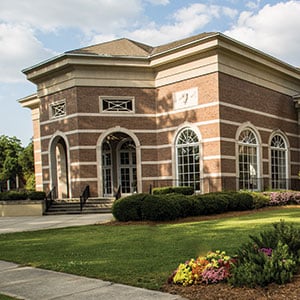

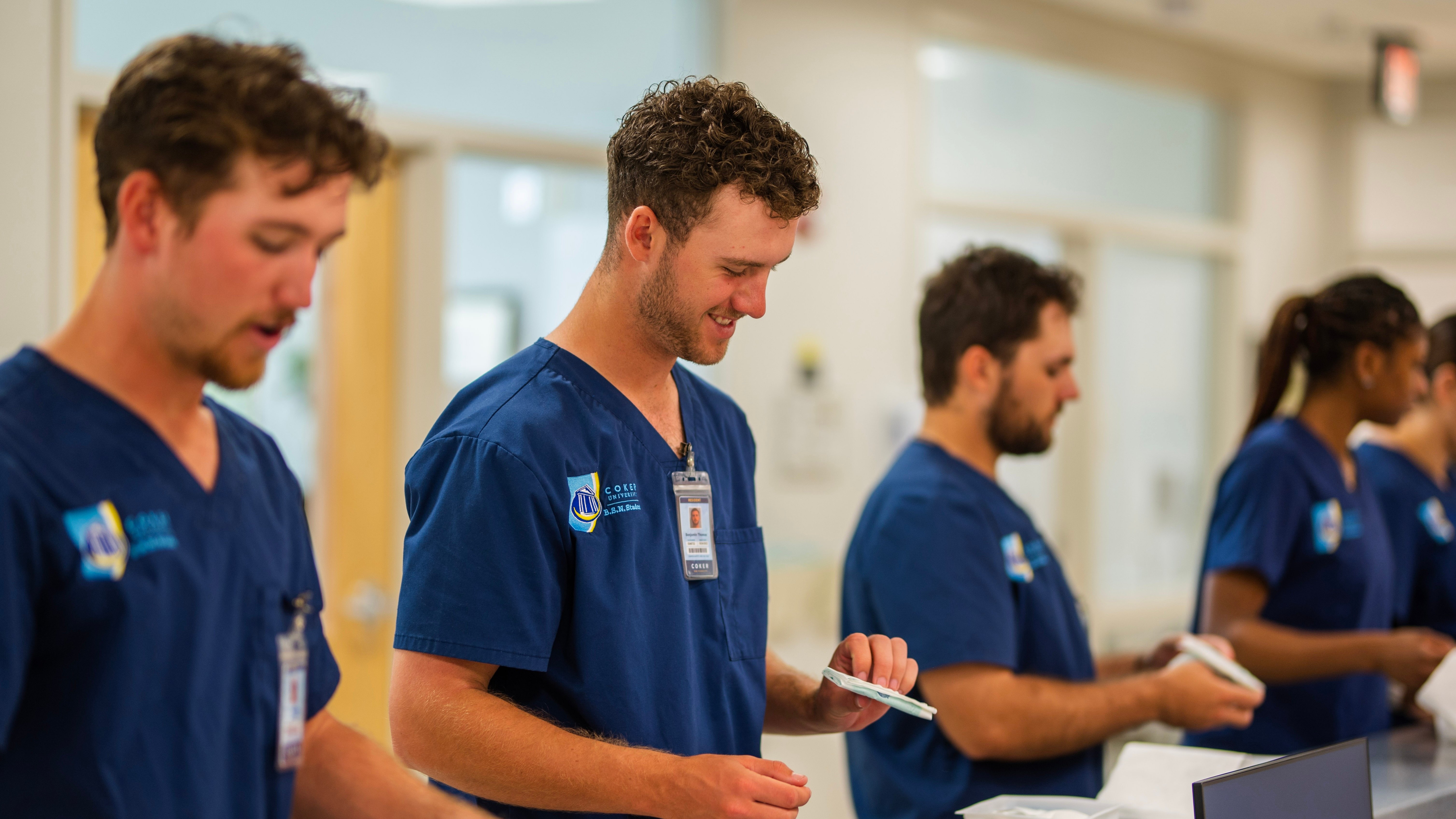
A new advanced learning lab is taking shape in the Timberlake-Lawton Physical Education Building on Coker University’s campus, expanding hands-on learning opportunities for nursing and health professions students while strengthening the University’s connection to the region’s healthcare community.
Funded through a $2 million federal grant awarded in 2024, the lab will boost long-term program growth. The grant was earmarked for nursing support, lab renovation, and equipment and supply upgrades. As renovation plans progressed, the opportunity emerged to create a dedicated advanced learning lab that could serve not only nursing students, but multiple health professions programs.
The lab addresses a long-standing need for flexible space. Designed to support a wide range of academic and clinical activities, the facility includes computer rooms, classroom space for large cohorts, storage for supplies and equipment, and dedicated simulation-based learning areas. The space also provides a solution for proctored testing, something the program previously lacked.
“This lab allows us to bring multiple components of our program together in one place,” said Dr. Eileen Klang, Dean of the College of Health Professions. “It gives our students room to learn, practice, and build confidence before they ever step into a clinical setting.”
The lab is outfitted to support skills training across every semester of the nursing curriculum. Medium-fidelity mannequins, valued at approximately $80,000 each, allow students to practice core clinical skills, while the space is designed to eventually house high-fidelity mannequins that can cost up to $200,000 and simulate complex patient scenarios in real time.
Hospital beds donated by Carolina Pines Regional Medical Center further enhance the environment's realism, giving students experience with patient transfers and bedside care.
Beyond traditional nursing coursework, the lab supports CPR, BLS, ACLS, and PALS training for both adult and pediatric care. It is also a key resource for RN-to-BSN students, who come to campus several times each semester for intensive skills training. By relocating these activities to Timberlake, the program can ease space constraints at its Carolina Pines site while creating a more cohesive learning experience.
Coker’s nursing program follows a 1+3 model, with students completing a pre-nursing year before moving into 3 years of nursing coursework. Faculty intentionally pace instruction to help students manage the volume and complexity of clinical knowledge. Expanded lab access supports this approach, allowing students more time to practice pharmacology, medical surgical skills, and critical care scenarios in a controlled setting.
The advanced learning lab also strengthens Coker’s already robust clinical partnerships. Relationships with McLeod Health, Medical University of South Carolina, and Carolina Pines play a critical role in preparing students for the workforce and encouraging graduates to remain in the region. These partnerships contribute to local economic impact by helping address workforce needs by training nurses close to home.
“We’re really here to support each other in the Upper Pee Dee area,” Dr. Klang said.
Looking ahead, the University plans to pursue additional federal earmarks and grant funding to strengthen the lab’s capabilities and expand advanced simulation opportunities on campus. These investments would bring more advanced simulations on campus, giving students consistent, hands-on practice while continuing to strengthen Coker’s connection to the healthcare community.