

 As the United States approaches the 250th anniversary of the American Revolution, one Coker University student is asking a simple but important question: What does this moment mean to us now?
For Humanities major Harper Davidson, that question became the foundation of a months-long research project examining how perceptions of the American Revolution have evolved from 1776 to today.
Davidson began her research in June 2025, working alongside Dr. Gina Bennett, Assistant Professor of Global Studies and Humanities Coordinator at Coker. What started as a different research direction quickly shifted after early conversations about the significance of the upcoming anniversary.
Growing up in Charleston, Davidson already felt a personal connection to Revolutionary history. That connection shaped a project that blends historical analysis with present-day perspectives.
“This research really looks at how people have understood the American Revolution over time,” Davidson said. “Not just what happened in 1776, but how each generation has interpreted it and why that still matters.”
Bridging the Past and Present
Davidson’s work draws from a mix of historical and contemporary sources. She analyzed primary documents, including Frederick Douglass’s reflections on American independence, alongside archival materials, such as The New York Times coverage from 1876.
But her research did not stop in the past.
To better understand how the Revolution is viewed today, Davidson conducted a campus-wide survey, gathering responses from students, faculty, and staff. What she found revealed a noticeable gap in historical awareness across generations.
“Older individuals tended to have a deeper understanding of the American Revolution and its significance,” she explained. “But many students had more surface-level knowledge or misconceptions.”
Perhaps most striking was the lack of awareness surrounding the 250th anniversary itself.
“A lot of people didn’t even realize it was coming up,” Davidson said. “That was surprising, especially for something that has shaped so much of our country.”
At the same time, the project pushed Davidson to grow as a researcher. Managing a long-term project, balancing timelines, and working through challenges over the summer required discipline and focus.
“I feel more accomplished after finishing something this big,” she said. “It taught me how to manage a long-term project and trust the process.”
Why Historical Memory Matters
At the heart of Davidson’s research is the idea of historical memory. Not just what we remember, but how and why we remember it.
Her findings suggest that as time passes, major historical events can lose visibility in everyday conversations, even when their impact remains deeply embedded in society.
“History does not just stay in the past,” Davidson said. “It influences how we think about current issues, from government and rights to the way we interact with each other.”
She also noted that modern challenges, including political polarization and the influence of social media, have changed how people engage with history and with one another.
“There is less shared understanding than there used to be,” she said. “That makes it even more important to revisit these moments and talk about them in meaningful ways.”
A Collaborative Effort
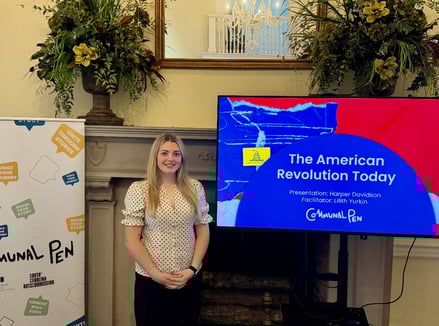
Davidson’s research has also extended beyond Coker’s campus through a partnership with Coastal Carolina University’s Communal Pen and support from the South Carolina Arts Commission.
Through this collaboration, students from both institutions gathered for the Communal Pen event at Drengaelen on March 20, an interactive experience focused on reflection, writing, and discussion of the American Revolution's meaning today.
The project has received strong institutional support, including contributions from Athenaeum Press, a Coastal Carolina University press, which provided professional design and promotional materials under the direction of Alli Crandell, Director of the Athenaeum Press and Digital Design.
Dr. Bennett said she has been impressed with Davidson’s commitment and growth throughout the process.
“I am very proud of the work that Harper Davidson has already done on this project,” Bennett said. “There is real potential for her research to gain visibility and lead to future publishing opportunities.”
Looking Ahead
Davidson plans to share her full findings at Coker’s Student Research Symposium on April 8.
After graduation, she hopes to pursue a master’s degree in English, possibly earn a Ph.D., and eventually build a career as an editor or author.
For now, she hopes her research encourages others to take a closer look at the past and consider its place in the present.
“The American Revolution is not just something we learn about in a textbook,” Davidson said. “It is something that still shapes who we are. The more we understand it, the better we can understand ourselves.”